The Bust of Nefertiti at the Neues Museum
Where exactly she stands
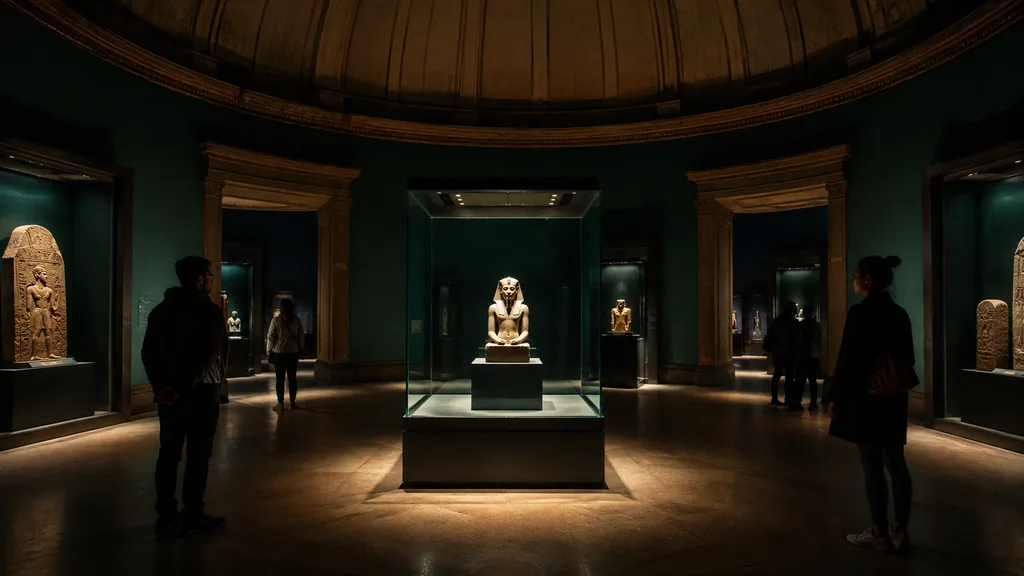
The North Dome Room is on the second floor, and the bust has it entirely to herself. That's a curatorial decision with consequences: there's no row of display cases beside her, no second attraction in the same room, nothing to distract. The room's colour scheme, green and blue, was chosen so that the blue crown stands out. Anyone coming from the staircase hall can therefore already see her from some distance.
The way there leads from the James-Simon-Galerie into the Neues Museum and then upward. Go there first, before you get stuck on the ground floor — the room gets fuller over the course of the day and doesn't empty out again. How to reach the entrance is explained at Getting there.
How she came to Berlin
The bust comes from the German excavations at Amarna, which took place between 1911 and 1913. Since 1913 she has been in Berlin. She initially belonged to the private collection of the merchant and patron James Simon, who 1920 donated her to the Egyptian Museum. You'll encounter the name again at the latest when you enter: the entrance building of Museum Island is called the James-Simon-Galerie.
What you're actually looking at
The bust is made of limestone and covered with a painted stucco surface . It was created during the Amarna period under Akhenaten, roughly between 1353 and 1336 BC. That explains a good deal of her effect: Amarna art works in softer, more fluid forms than the Egyptian pictorial conventions before and after it. What most visitors notice first is the colouring — and that one eye is unfinished.
Reactions to her are unusually consistent. Amber from the UK wrote on 5 July 2026 that Queen Nefertiti was the most beautiful thing she had ever seen. Paolo from Italy called the Egyptian collection especially beautiful on 22 August 2026, above all the bust. People rarely write sentences like that about a display case.
The photo rule, and why it's enforced
Photography is prohibited in the North Dome Room. That's not a recommendation but a rule the staff enforce. Photography is permitted from the adjoining room — from there you have the bust in view through the doorway, and you've probably already seen exactly this image. Guided groups are also asked to give their explanations in the rooms before it, so that the room itself stays quiet. Full details are at Photography in the Neues Museum.
Put your phone away while you're in the room. The two minutes in which you do nothing else are the actual reason for the visit — take your photo afterwards from next door.
When you're almost alone
The room is small, and the bust is the reason many people come at all. Everything accordingly depends on the time of day. On weekdays right at opening at 10am, you're ahead of the tour groups. On weekdays after 3pm, it quiets down a second time. At weekends only the window between 11.30am and 1pm remains, and even that's a compromise. The full overview is at the Opening hours.
Stay in the building afterwards
Anyone who's back outside after twenty minutes has only half-used the ticket. In the same building you'll find the Berlin Green Head, the Gold Hat, the Troy finds and a Neanderthal skull; this is covered at what there is to see. Which ticket you need for all of this, we explain at Admission and Tickets.
Frequently asked questions
Where does the bust of Nefertiti stand?
In the North Dome Room on the second floor of the Neues Museum on Berlin's Museum Island, in a room of her own. The entrance for all visitors is the James-Simon-Galerie, see Getting there.
Is it allowed to photograph Nefertiti?
Not in the North Dome Room — photography is prohibited there and the rule is enforced. You may take photos from the adjoining room.
How old is the bust of Nefertiti?
It was created during the Amarna period under Akhenaten, roughly between 1353 and 1336 BC, from limestone with a painted stucco surface.
How did Nefertiti come to Berlin?
From the German excavations at Amarna between 1911 and 1913; she has been in Berlin since 1913. She was part of James Simon's private collection until he donated her to the Egyptian Museum in 1920.
When is it quietest at the Nefertiti bust?
On weekdays at opening at 10am or from 3pm; at weekends between 11.30am and 1pm. More on this at the Opening hours.